
Supported by Water Institute facilitation expertise , working groups convene scientists, end users, government agencies, utilities, and private sector organizations to identify shared research priorities, synthesize existing knowledge, and develop actionable solutions that inform water management and policy. Each group is intentionally focused in scope, scale, and theme to respond to current and emerging water needs locally and globally.
Our Current Working Groups

Building Research Initiatives and Dialogue for Greater Everglades Science (BRIDGES)
The Water Institute and the School of Natural Resources and Environment have partnered with various academic units across the University of Florida to connect a cohort of University of Florida faculty with the managers, decision makers, and researchers engaged in the restoration of America’s Everglades. The cohort, comprised of faculty from multiple departments, will participate in workshops and webinars to strengthen their scientific foundation of the Everglades while building connections with agencies involved in the Everglades restoration.
Bridging the Gap: Integrating Water Resource Management and Ecosystem Science for Climate Adaptation in Florida
This project addresses Florida’s water and ecosystem challenges—worsened by a changing climate and increase land-use change—by bringing together scientists and resource managers to co-develop climate-informed strategies. Building on an iterative structure created by FloridaWCA, it will use structured engagement to identify knowledge gaps, align priorities, and create a coordinated research roadmap, leading to a shared agenda and a stronger practitioner network.

Florida Water Quality and Quantity Enhanced Synthesis Tools (FLOWQU2EST)
Nutrient contamination is one of the most important water quality challenges in Florida and globally. Despite enormous investments in monitoring and projects to address water quality challenges in Florida, the disparate nature of the observations and the long list of potential spatial and temporal drivers has limited integrative statewide assessments. FLOW QU2EST seeks to remedy this by connecting, for the first time, readily available nutrient measurements, key covarying constituents, watershed and network attributes, and measured and modeled discharge. This effort enables new synthesis to address causes and patterns of water quality variation, leveraging modern analytical workflows to generate a robust prediction engine.
Our Past Working Groups
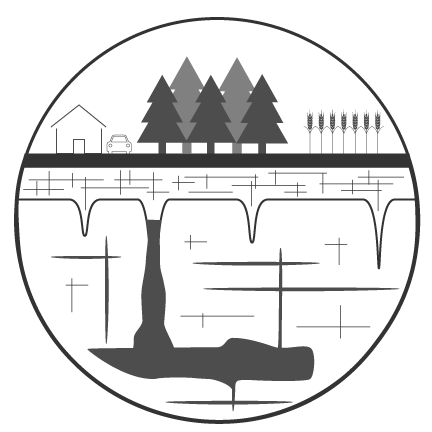
Carbonate Critical Zone Research Coordination Network (RCN)
This project aimed to advance transdisciplinary and collaborative science to enhance the understanding of carbonate-rich Critical Zones. The network hosted workshops, webinars, training sessions, and coordinated three working groups. The working groups concentrated on completing data synthesis, writing synthesis papers, identifying potential funding opportunities for future collaborations, and presenting results at professional meetings.
Collaborate With Us
Have a research project idea or need to utilize the Water Institute’s expert services?