
Share
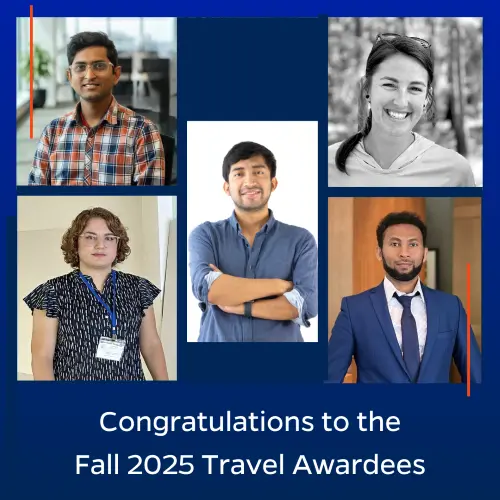
Congratulations to the Fall 2025 Travel Awardees
The Water Institute congratulates Amanda Chappel, Nikhil Deep, Fabian Quichimbo, Saba Shaghaghi Khajehdehi, and Bewuket Tefera as recipients of the Fall 2025 Water Institute Travel Awards. The financial assistance provided by the award will be used for the recipients to travel to their international or national conference. There, they will present their research, network with professionals, and further develop their academic and professional skills.
The Water Travel Awards are offered every semester to undergraduate and graduate students whose research focuses on terrestrial water and its connection with human, coastal, or atmospheric systems.
Stay tuned to our listserv and social media for opportunities to learn about their research at upcoming Water Institute events.
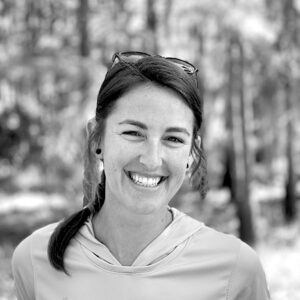
Amanda Chappel
Engineering School of Sustainable Infrastructure & Environment
Conference: Coastal and Estuarine Research Federation – CERF 2025
Presentation Title: Carbon and Nutrients in Seagrass and Macroalgae Biomass Reveal Drivers and Mechanisms of Resilience in Submerged Aquatic Vegetated Habitats

Nikhil Deep
Soil, Water, and Ecosystem Sciences
Conference: American Geophysical Union (AGU)
Presentation Title: High – Resolution Root Zone Soil Moisture Mapping Using a UTV-Mounted L-Band Radiometer Over Hemp Crop in Florida

Fabian Quichimbo
Geology
Conference: American Geophysical Union (AGU)
Presentation Title: Enhancing Breakthrough Curve Analysis Via Automated Curve Fitting-Based Spectral Deconvolution

Saba Shaghaghi Khajehdehi
Soil, Water, and Ecosystem Sciences
Conference: American Geophysical Union (AGU)
Presentation Title: Hydrologic Modeling of Surface Water Flow in the Peace River Basin Using SWAT+

Bewuket Tefera
Geography
Conference: American Geophysical Union (AGU)
Presentation Title: Deep Learning-Based Prediction of GRACE-Derived Terrestrial Water Storage Anomalies in the Nile Basin (2003–2024) Using a CNN-LSTM Approach